The Es Vedrà Energy — What People Experience
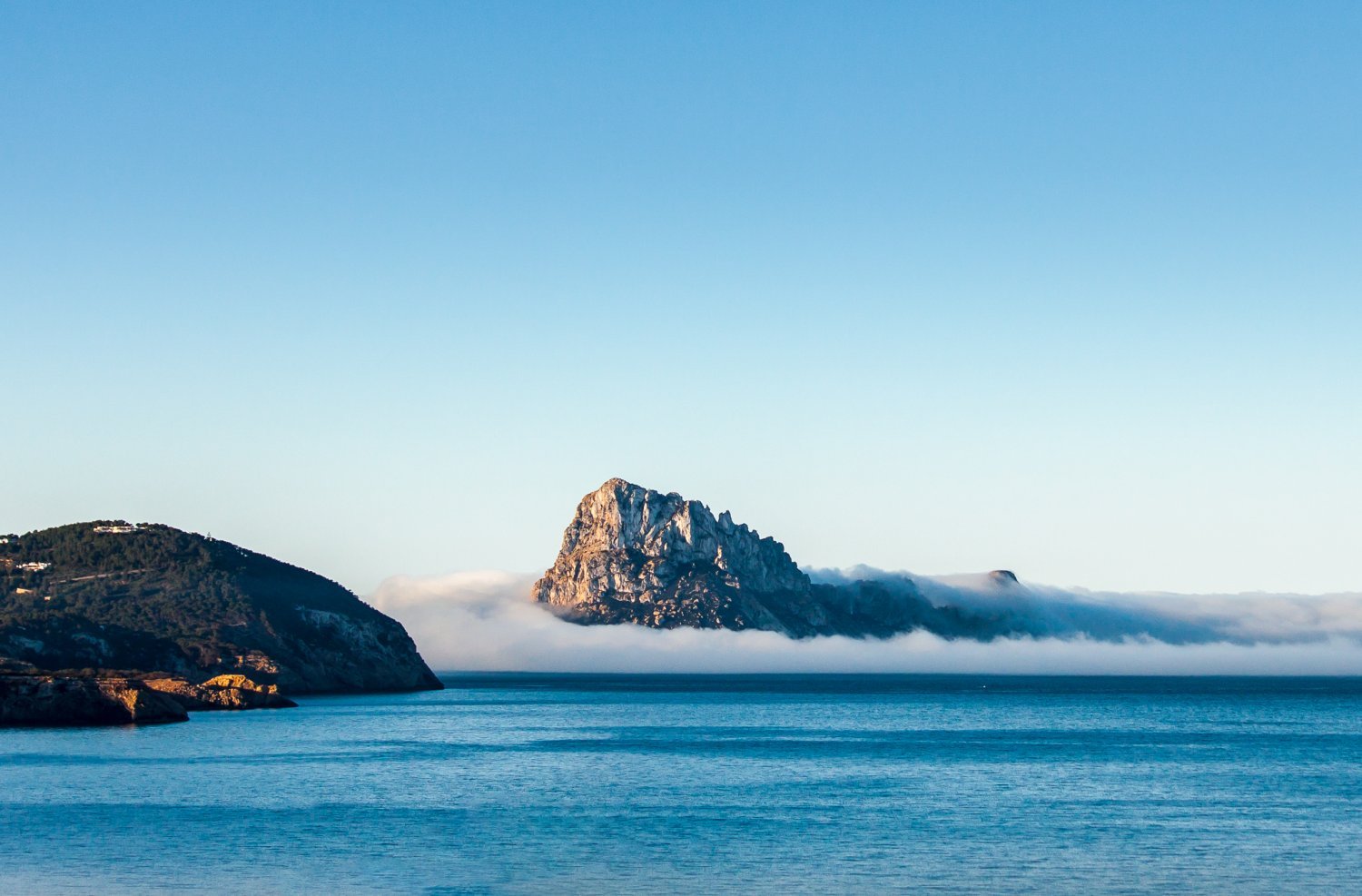
Visitors from every cultural and religious background report a consistent experience at Es Vedrà: a feeling of heightened presence, inner stillness, or undefined power that is difficult to explain. Some describe it as the most spiritually charged place they have ever visited. Others simply notice that the island holds their attention in a way nothing else does.
Understanding why Es Vedrà affects people this way requires looking at three distinct threads: the documented history of spiritual connection to the island, the Tanit tradition in Ibiza, and what psychology can tell us about how environments generate subjective spiritual experiences.
The Goddess Tanit and Ibiza's Sacred Geography
Tanit was the principal goddess of Carthage and the Phoenician world — a deity of the moon, fertility, and the sea. The Phoenicians established a significant presence on Ibiza from approximately 654 BCE, and Tanit became the central divine figure of the island. Her temple complex, Es Cuieram, located in a cave in the north of Ibiza, has yielded hundreds of votive offerings dating from the 4th to 2nd centuries BCE — the largest Phoenician sanctuary ever discovered in the western Mediterranean.
Tanit is still woven into Ibiza's cultural identity: her symbol, an abstract triangular figure with a horizontal line and circle, appears throughout the island in jewellery, ceramics, and public art. Many visitors come to Ibiza specifically for a connection with what they perceive as the feminine divine energy that Tanit represents.
Es Vedrà, positioned at Ibiza's most southwestern point — the direction of the setting sun in ancient cosmologies — has been identified by some researchers in sacred geography as a possible site of Tanit-related power. No archaeological evidence supports a Tanit temple or sanctuary on Es Vedrà specifically, but its relationship to Es Cuieram across the island (roughly east-west) has led to speculation about ley line alignments.
The Spiritual Vortex Claim
Es Vedrà is frequently described in New Age and spiritual tourism literature as an energy vortex — a point where multiple ley lines converge to create a concentrated field of spiritual energy. Similar claims are made about Sedona, Arizona; Glastonbury, England; and Machu Picchu, Peru.
What the evidence says: Ley lines are not recognised by physics or geophysics. They are a 20th-century concept introduced by Alfred Watkins in 1921 to describe alignments between ancient sites — alignments that mathematicians have since shown are statistically inevitable when you have enough points on a map. The vortex claim at Es Vedrà has no scientific basis.
However, the consistency of spiritual experiences reported at Es Vedrà across very different visitors — including people with no prior belief in vortexes — points to something real, even if the mechanism is psychological rather than geophysical.
Francisco Palau's Documented Visions
The most historically solid spiritual connection to Es Vedrà belongs to Blessed Francisco Palau y Quer, a Carmelite friar who used the island as a hermitage between 1860 and 1866. Palau was a mystic and writer who documented his contemplative experiences in detail. His writings describe visions of profound spiritual depth experienced during his time on Es Vedrà.
Palau was beatified by Pope John Paul II in 1988, giving him the title Blessed Francisco Palau — the Catholic Church's formal recognition of his holiness. His documented history on Es Vedrà is, therefore, not legend or speculation but a matter of religious and archival record.
For visitors approaching Es Vedrà within a Christian spiritual framework, Palau's presence gives the island a specific, documented sanctity. For others, his experience serves as evidence that the island has generated profound spiritual encounters across centuries.
Why the Energy Feels Real — Psychology and Environment
The question of why Es Vedrà produces such consistent spiritual responses in visitors is partly answered by environmental psychology:
- Awe induction: Es Vedrà is large, visually dominant, and dramatically shaped. Research on awe consistently shows that vast, imposing natural features trigger a distinctive emotional state associated with feelings of smallness, presence, and transcendence.
- Isolation: The rock is uninhabited and inaccessible. Humans are wired to project meaning onto unreachable places. The island's protected status paradoxically amplifies its mystique.
- Expectation: Most visitors arrive already primed by stories of Es Vedrà's spiritual power. Expectation bias is well-documented — people find what they expect to find, especially in ambiguous, emotionally charged settings.
- Sunset timing: Most people encounter Es Vedrà at golden hour, one of the most emotionally evocative lighting conditions in nature. The same rock at midday in flat light produces markedly fewer reports of spiritual intensity.
Spiritual Experiences at Es Vedrà Today
Es Vedrà has become one of the most popular destinations for spiritual tourism in the Mediterranean. Retreat centres in southwest Ibiza run programs that incorporate the view of Es Vedrà as part of guided meditation, kundalini yoga, and sound healing sessions. Several sunset boat tours have been designed specifically around meditative and spiritual frameworks — slow, silent circumnavigations of the rock at dusk.
The Sunset Yoga Cruise, which combines guided yoga on the water with the view of Es Vedrà at golden hour, has become one of the most consistently described transformative experiences available in Ibiza. For visitors drawn to Es Vedrà for spiritual reasons, this format — on the water, facing the rock, at the time of day when its presence is most powerful — is considered the optimal way to encounter it.
What to Take Away
Es Vedrà's spiritual power is neither purely myth nor purely science. The island generates real experiences in real people — experiences that cut across belief systems and cultural backgrounds. Whether the mechanism is a Tanit connection, a geological energy field, Palau's residual sanctity, or the psychological alchemy of awe plus expectation plus sunset, the result is the same: people leave Es Vedrà changed.
That, at least, is documented fact.